
Careers
Nail Technician Careers in Southeast LA: What the Work Looks Like
By Maiquela’s Cosmetology Academy6 min read
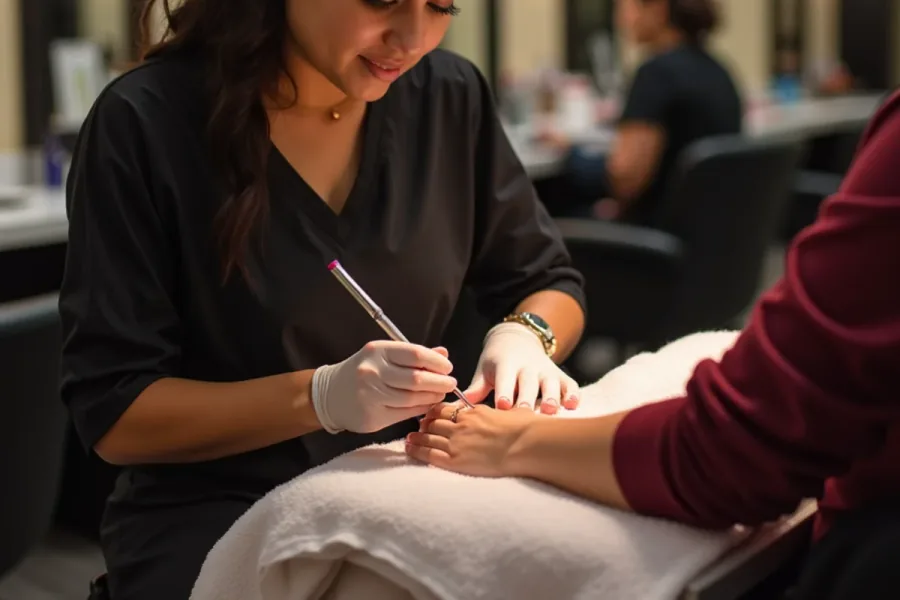
A California manicurist licence takes 400 hours — the shortest the state issues. Nail technicians in Southeast LA typically earn through a mix of commission, per-service rates and tips, and the ones who do best specialise into structured acrylic, ombré and nail art rather than competing on price for basic gel polish.
Nail technology is the most underrated licence in California beauty. It is the shortest, the cheapest, the fastest to income, and it has the lowest barrier to working for yourself. It is also more technical than people outside the trade assume.
What the work actually involves
You are seated, working at close range with your hands, with one client in front of you for anywhere from forty-five minutes to two and a half hours. It is meticulous and it is social — nail appointments are long and clients talk.
The technical content is real. Acrylic chemistry, bead consistency, apex placement and structure, e-file control, gel curing and safe removal, and nail pathology. A technician who does not understand structure produces sets that pop in five days; one who does not understand pathology services a client they should have turned away.
How nail technicians get paid
Usually some combination of three things: a commission split with the salon, a per-service rate, and tips. The mix varies enormously by salon, and it is worth understanding the specific arrangement before accepting a chair.
What actually determines earnings is less the licence and more three variables: what services you can perform, how fast you are, and how many clients rebook. A technician who only does basic gel polish competes on price with every salon in the neighbourhood. One who does structured acrylic, clean ombré and freehand art does not.
Booth rent versus commission
Here is where nails has a genuine structural advantage. A nail table is the cheapest station to rent in almost any salon. You are not renting a chair, a colour bar and a backwash unit — you are renting a table, a lamp and space for your product.
That makes the jump from employee to self-employed smaller than in any other beauty discipline, and it makes the arithmetic worth learning early. Know what a week of rent costs. Know what a full set nets you after product. Work out how many sets a week covers the rent, and how many clear it.
Do that calculation before you graduate and you will make far better decisions about your first job than someone who takes the first offer they get.
The Southeast LA market specifically
Nail salons are dense across Huntington Park, South Gate, Lynwood, Downey and Bell Gardens. That means competition, and it also means a large, established client base that already treats nails as a routine expense rather than a luxury.
The event economy adds a second layer. Quinceañeras, weddings and graduations run heavily through this community on a seasonal calendar, and a technician who can do a full set of nails for a family group books out an entire morning from one event and gets referred through the whole family afterward.
Spanish is a commercial asset here, not a limitation. A technician who consults comfortably in Spanish keeps clients that a technician who cannot does not.
The portfolio does your marketing
This is the single most useful habit to build from your first week on the clinic floor. Photograph every good set. Consistent lighting, clean background, sharp focus on the nails.
Nail work is visual and it travels. Technicians in this market build client bases through social media in a way stylists and estheticians find harder, because a photograph of a good set sells itself with no explanation. The technicians who treat their first year as portfolio-building are the ones with full books in year two.
The physical side, honestly
Nail work is easier on the feet than hairdressing and harder on the neck, shoulders and wrists. Dust and product vapour are real occupational exposures, which is why ventilation and personal protective equipment are regulated and examined rather than optional.
Technicians who last set up their station ergonomically from the start, wear the mask, use the ventilation and take the posture seriously. Those who do not tend to develop problems in year three that they spend the following decade managing.