
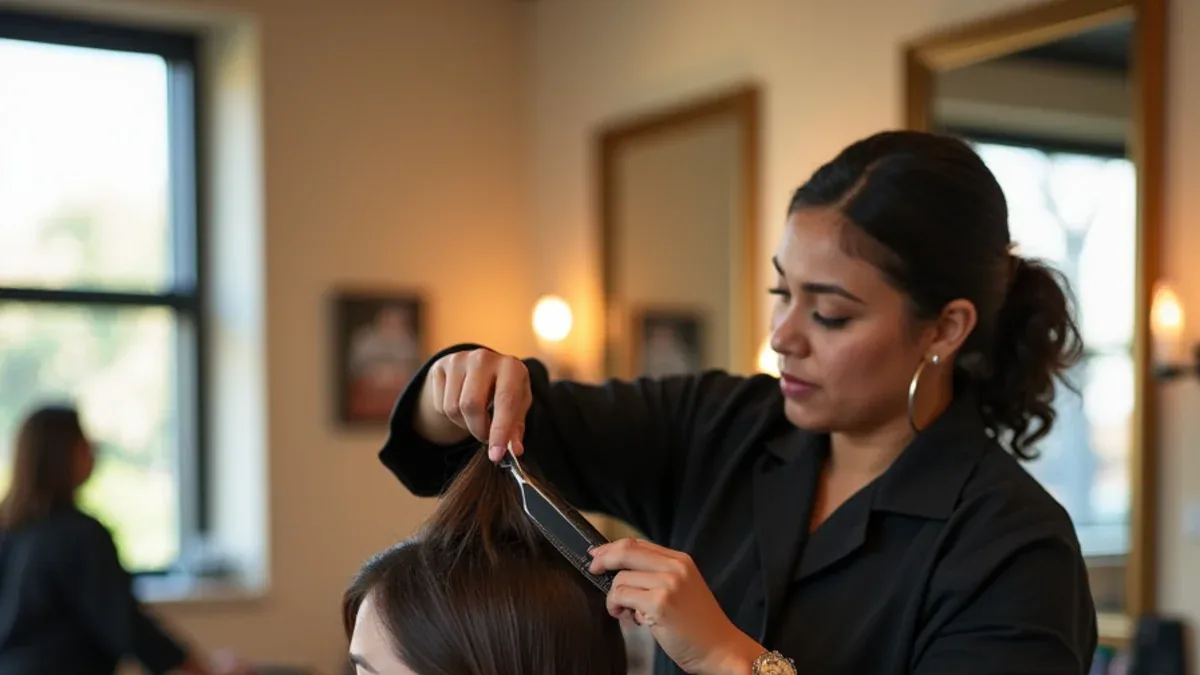
Our cosmetology program is a 1,000-hour course in South Gate, California that prepares you for the California Board of Barbering and Cosmetology written licensing exam. It covers hair cutting, colouring, chemical services, skin care and nail care, and every hour is taught in Spanish with English textbooks and English testing available on request. Call (323) 587-1750 to ask about the next start date.
Cosmetology is the widest licence California issues in the beauty trades. One licence covers hair, skin and nails, which means one licence covers almost everything a salon floor in Southeast Los Angeles actually charges for. That breadth is the reason most students who walk into our South Gate campus on Long Beach Blvd start here rather than with a single-discipline course.
Since Senate Bill 803 took effect on January 1, 2022, the state requires 1,000 hours of training for a cosmetology licence — down from the 1,600 hours that applied for decades. The same bill removed the practical exam. You now qualify on a written examination alone. A lot of the information still circulating in this neighbourhood is out of date on both points, and we would rather you hear the current version before you commit a year of your life.
What has not changed is that hours have to be earned in a classroom and on a clinic floor, in front of an instructor, on real heads of hair. The program is structured around that reality.
¿Es Para Usted?
Is the cosmetology program the right starting point?
Cosmetology is the longest of our licence programs, so it is worth being honest about who it suits. These are the signals that point toward cosmetology rather than a shorter course.
- You want to work behind a chair doing hair, and you do not want your licence to stop you from adding facials or nail services later.
- You are aiming to rent a booth or open your own salon eventually — a cosmetology licence keeps the widest range of services on your menu.
- You can commit to a schedule over roughly a year rather than a few months, whether that is mornings, afternoons or a mix.
- You are more comfortable studying in Spanish than in English, and you have been turned away or talked over somewhere else because of it.
- You have done hair informally for family and friends for years and want the licence that makes it legal to charge for it.
- You are not sure yet whether hair, skin or nails is your thing, and you want the training that keeps all three doors open.
Requisitos
Am I eligible to enrol?
This is the question that comes before every other question, and for a lot of people the answer is better than they expect. These are the rules the State of California sets for a cosmetology licence.
- You need to have completed the 10th grade. California does not require a high school diploma or a GED to sit the licensing examination — tenth-grade completion is the state education minimum.
- You need to be 17 by the time you apply for the state examination. You may start school before your seventeenth birthday, as long as you reach 17 by the point you apply to sit the cosmetology examination.
- A Social Security Number is not required. California allows its professional licensing boards to accept an Individual Taxpayer Identification Number instead. Bring your ITIN and government-issued photo identification.
- Hours from another California school may count. If you started a program somewhere else and stopped, bring the documentation. Whether the hours transfer is a specific conversation rather than a general rule, so ask before you assume either way.
Two things worth being clear about. These are the *state* minimums — every school also sets its own admission policy, and some require a diploma or GED regardless of what the state asks for. And requirements change. Call (323) 587-1750 to confirm what this academy requires, and verify the state rules directly with the California Board of Barbering and Cosmetology before you apply.
Plan de Estudios
What the 1,000 hours cover
- Hair cutting and shaping
- Sectioning, elevation, graduation, layering, razor and shear work, clipper work over the comb, and the discipline of cutting to a shape rather than to a length. You start on mannequins and move to live models on the clinic floor once your instructor signs you off.
- Hair colour and chemistry
- The level system, underlying pigment, formulating for grey coverage, single-process versus double-process, lightener strength and timing, toners, and the corrective work that follows a colour gone wrong. Colour is where new stylists lose money and clients, so it gets weight.
- Chemical texture services
- Permanent waving, chemical relaxing, keratin-style smoothing and the strand and patch testing that has to come first. You learn the hair structure behind each service so you can tell when a head of hair cannot safely take one.
- Skin care and facials
- Skin analysis, cleansing and exfoliation, basic facial massage, masks, hair removal by wax and tweezers, and contraindications — the conditions where the correct answer is to refer a client to a physician rather than treat.
- Nail care
- Manicures, pedicures, artificial nail systems, gel and acrylic application, and nail disorders. Cosmetology covers nails, but at less depth than the dedicated manicurist course.
- Health, safety and California law
- Disinfection, sanitation, bloodborne pathogen protocol, infection control, and the sections of the Barbering and Cosmetology Act that the written exam draws from. This block is the single largest source of exam questions.

El Proceso
How the program runs, start to licence
Visit the campus and talk it through
Come to 8511 Long Beach Blvd, see the clinic floor, and ask what you actually want to ask — hours, schedule, cost, what happens if you have to miss a week. Nothing about this conversation is a commitment.
Enrolment and paperwork
We go through the enrolment agreement line by line, in Spanish, before anything is signed. You get the schedule, the kit list and the attendance policy in writing.
Theory and mannequin work
The first phase is classroom instruction plus practice on mannequin heads. This is where cutting patterns, colour formulation and sanitation become automatic before a paying client ever sits in your chair.
Clinic floor with live models
Once you are signed off, you work on real clients in the student salon under instructor supervision. Members of the public book these services, so you learn consultation, timing and pressure alongside technique.
Hour tracking and progress checks
Hours and completed operations are logged as you go. You always know how many of the 1,000 you have banked and what remains.
State board exam preparation
The final phase turns toward the written NIC examination — practice questions, law and safety review, and test-taking strategy. The exam is offered in Spanish.
Apply, test, get licensed
We help you assemble the application to the California Board of Barbering and Cosmetology and book the exam date. Passing it is what turns 1,000 hours into a licence.
Why 1,000 hours instead of 1,600?
Senate Bill 803 reduced California cosmetology training from 1,600 hours to 1,000 hours effective January 1, 2022, and cut barbering from 1,500 to 1,000. The legislature took the position that the extra 600 hours were adding cost and time without adding competence. The same law eliminated the practical exam, leaving a written examination as the only test standing between a graduate and a licence.
For a student in South Gate, the practical effect is roughly four to six months less time in school and a materially smaller total cost. It also means anyone who tells you the course is 1,600 hours is working from information that is now several years stale.
Studying in Spanish, testing in either language
Instruction here is in Spanish. That is not a translation layer bolted onto an English course — it is how the classroom runs, how questions get asked and how techniques get explained. Students who have sat through a half-understood English lecture somewhere else usually notice the difference inside a week.
Testing is a separate decision from instruction. The California written examination is available in Spanish, and it is also available in English. Bilingual students regularly take theory in Spanish, request English textbooks, and sit the exam in English. Both routes lead to the same licence.
What a cosmetology licence lets you do in Los Angeles County
A California cosmetology licence lets you cut, colour and chemically treat hair, perform facials and hair removal, and provide manicure and pedicure services — as an employee, as a booth renter, or as the owner of your own establishment once the shop itself is licensed.
In practice, most graduates in the Gateway Cities start as an assistant or a commissioned stylist in an existing salon along Pacific Boulevard, Tweedy Mile, Firestone Boulevard or Atlantic Avenue, build a book of clients over a year or two, and then decide between booth rental and staying on commission. The licence is the part the state controls. The client book is the part you control.
Costo
What drives the cost of a cosmetology program
We do not publish tuition figures on this page, because the honest answer depends on your schedule and what you already own. These are the variables that move the number. Call (323) 587-1750 and we will give you the real figure for your situation.
Program length
Cosmetology is 1,000 hours. It is the longest program we run, and length is the largest single cost driver in beauty education anywhere in California.
Kit and supplies
Shears, clippers, mannequin heads, brushes, colour bowls, a rolling case. Some students arrive with tools already; most do not. What you need is itemised before you enrol, not discovered later.
Textbooks and language choice
Spanish and English textbook sets are both available. The choice does not change tuition, but it is worth deciding before books are ordered.
State fees
The application and examination fees go to the California Board of Barbering and Cosmetology, not to the school. They are set by the state and change independently of tuition.
Payment schedule
Paying across the length of the program rather than up front changes what you write each month. Ask about the payment plan options when you call.
Attendance pattern
Missed hours have to be made up. A student who attends consistently finishes sooner and pays less in total than one who stops and restarts.