
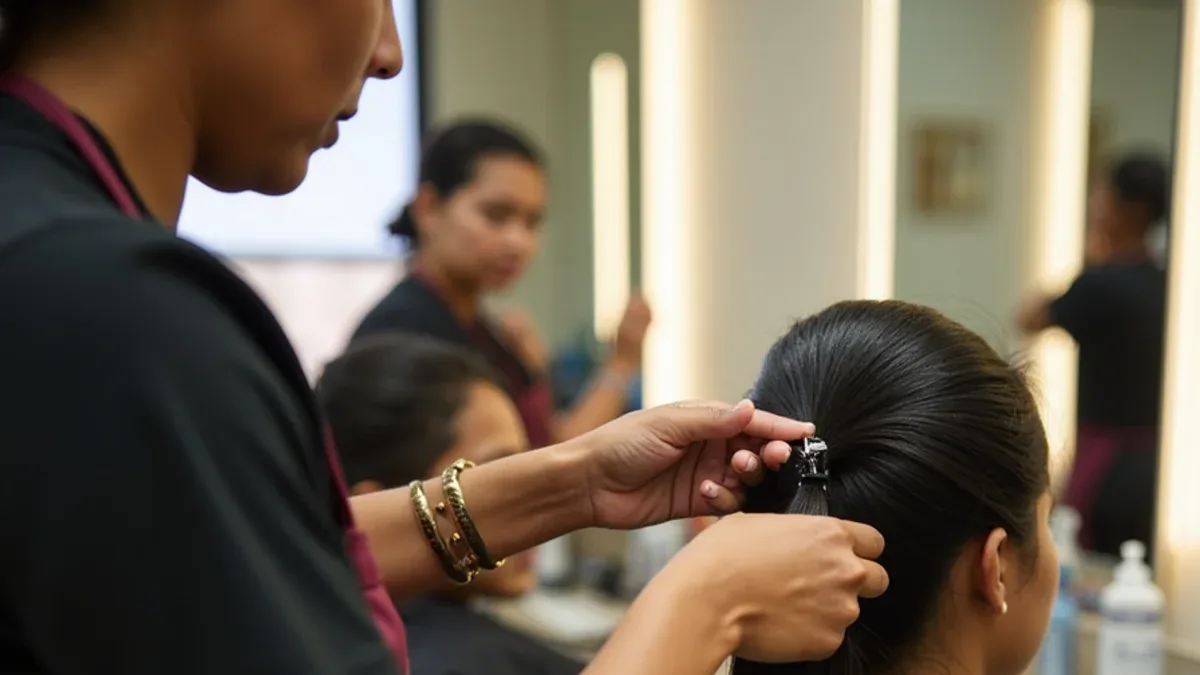
Hair cutting, colour and styling training in South Gate, California builds the three skills a salon floor pays for: a clean cut, a colour that lifts to target, and a finish a client can repeat at home. It is delivered inside the cosmetology program and as focused skill-building for licensed stylists. Call (323) 587-1750.
Hair is where most of the money is in a salon, and hair is where most new stylists struggle. Not because cutting is unusually hard, but because it is unforgiving — a cut that is wrong is wrong in front of the client, immediately, and a colour that pulls orange cannot be talked away.
This training treats those three disciplines as one connected skill. You cut to a shape. You colour to a target level knowing what the underlying pigment will do. You finish in a way that shows the client what they are actually going home with.
California does issue a standalone 600-hour hairstylist licence covering hair only. Most students here take hair inside the 1,000-hour cosmetology program instead, because the extra 400 hours also buy skin and nail services. If hair alone is genuinely all you want, ask us about the hairstylist route when you call.
¿Es Para Usted?
Who this training suits
Hair training is worth focusing on if these describe where you are.
- You are already in the cosmetology program and want more repetitions on cutting and colour than the minimum.
- You are licensed but your colour work is inconsistent and you know it is limiting what you can charge.
- You cut well but cannot lift and tone reliably, so you turn away blonde work.
- You want to move from an assistant role onto the floor with your own column.
- Your blowouts and finishing let good cuts down.
- You want to understand hair chemistry rather than following formulas you were handed.
Plan de Estudios
What the training covers
- Cutting fundamentals
- Sectioning, elevation, over-direction, and the four basic forms every haircut is built from. Once these are automatic, any cut becomes a combination of things you already know.
- Layering, graduation and texture
- Building weight and removing it, long and short layers, graduated shapes, point cutting, slide cutting, and texturising without destroying a line.
- Curly and coily hair
- Cutting curl by curl, dry cutting, shrinkage, and shaping textured hair to fall correctly. This is essential in Southeast LA and it is skipped or rushed in a lot of training.
- Colour theory and the level system
- Levels, tones, underlying pigment, and why lifting dark hair exposes warmth. Everything difficult about colour becomes predictable once this is understood.
- Formulation and application
- Single-process, grey coverage, root retouch, lightener and developer selection, foiling and balayage placement, toning and glossing.
- Colour correction
- Banding, hot roots, over-porous ends, brassiness and the box-dye repair job that walks into every salon. Correction is where technical knowledge becomes money.
- Blow-dry and finishing
- Tension and airflow, round-brush control, thermal styling, and set work. Finishing is the last thing a client sees and the thing they judge the whole appointment on.
- Consultation
- Reading what a client is asking for versus what they are describing, managing expectations on lift, and pricing the service before you start rather than after.
El Proceso
How hair training is structured
Assessment
We look at where your cutting and colour actually are — not where a certificate says they are — and build from there.
Mannequin repetition
Cutting patterns drilled until the sectioning is automatic. Repetition on mannequins is cheaper than repetition on clients.
Colour on swatches and mannequins
Lifting, toning and formulating on hair swatches, so you see underlying pigment behave before you meet it on a client’s head.
Live clients on the clinic floor
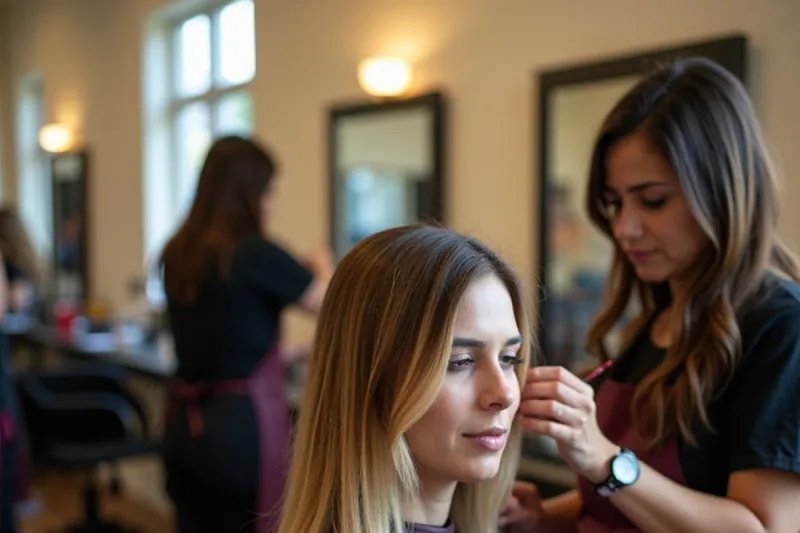
Supervised cutting and colour on real clients, with consultation and timing as part of the assessment.
Correction scenarios
Working through the failures deliberately — banding, brass, uneven lift — so the first time you see one it is not on a paying client alone.
The hairstylist licence versus the cosmetology licence
California issues a 600-hour hairstylist licence restricted to hair services, and a 1,000-hour cosmetology licence that covers hair, skin and nails. Four hundred hours separate them.
For most students the cosmetology licence is the better buy, because it keeps facials, waxing and nail services available without a second program. The hairstylist route makes sense if you are certain hair is all you will ever do and the shorter timeline is decisive. Talk it through with us before you choose — it is a decision that is expensive to reverse.
Textured and curly hair is not an elective here
A large share of clients in South Gate, Huntington Park, Lynwood and Compton have wavy, curly or coily hair. Training that teaches cutting only on straight mannequin hair produces stylists who cannot serve their own neighbourhood.
Curly cutting is a different discipline — dry cutting, curl-by-curl shaping, accounting for shrinkage, and knowing that tension applied at the wrong moment produces a cut that looks correct wet and wrong dry. It is taught as core content, not as a specialist add-on.
Why colour correction pays
Correction work commands the highest prices on most salon menus because it takes the most skill, the most time and the most risk. It is also the most common walk-in in this area, because home box colour is everywhere.
A stylist who can look at banded, over-porous, box-dyed hair and give an honest multi-session plan — rather than promising platinum in one sitting — is the stylist who keeps that client for years. Honesty in the consultation is a technical skill.
Costo
What affects the cost of hair training
Hair training cost depends mostly on whether it sits inside a licence program or alongside one.
Delivered inside cosmetology or standalone
Within the 1,000-hour program, hair training is part of tuition. As focused skill-building for a licensed stylist it is structured and priced separately.
Shear quality
Good shears are the tool worth spending on. They hold an edge, they cut cleanly, and they do not wreck your wrist over an eight-hour day.
Colour product usage
Colour and lightener are consumed in practice. More repetitions means more product.
Mannequin heads
Cutting and colour practice both consume mannequins, and human-hair mannequins that take colour cost more than synthetic ones.
Thermal and styling tools
Dryer, round brushes, irons and a wand. Finishing cannot be practised without them.