
Exam Prep
What the California State Board Exam Actually Asks (Written-Only Since 2022)
By Maiquela’s Cosmetology Academy7 min read
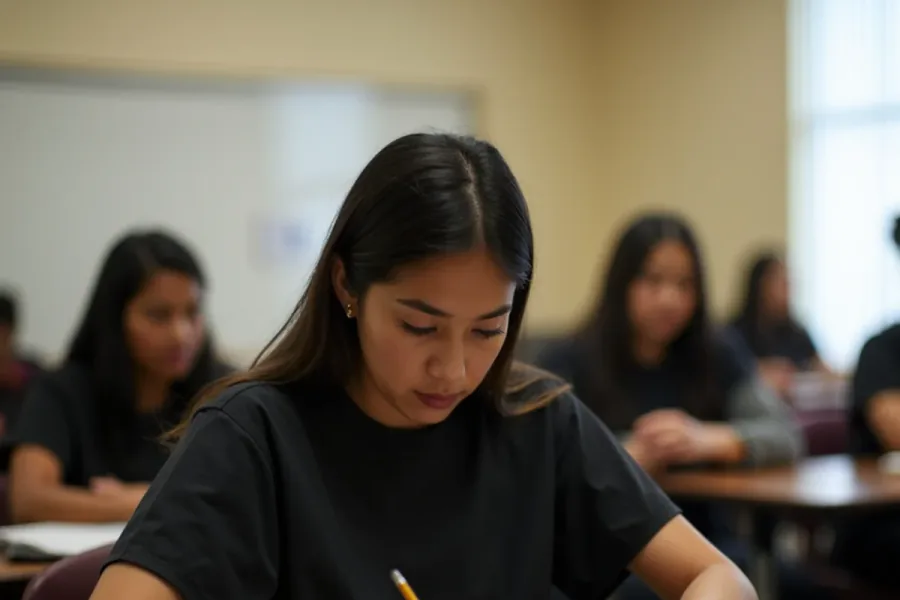
The California licensing exam is a written multiple-choice examination administered under the National-Interstate Council standard. Since Senate Bill 803 removed the practical exam in 2022, it is the only test required. It weights infection control, safety and California law most heavily, and it is offered in Spanish as well as English.
Everything you spent 400, 600 or 1,000 hours earning now comes down to one written paper. That is worth sitting with for a moment, because it changes where preparation effort belongs.
The exam changed in April 2026
If you were given a study plan before spring 2026, some of it is now pointing at the wrong things. A new PSI content outline took effect for all California candidates on 1 April 2026, and it moved the weightings considerably.
- Safety and infection control rose from 25% to 30% of the cosmetology paper — and it was already the biggest section.
- Haircutting collapsed from 12% to 3%. This is the one that catches people out. Cutting is the skill students practise hardest and it is now worth three marks in a hundred.
- Haircoloring became its own standalone category at 10%.
- Eyelash and eyebrow was added as a new category at 4%.
- Hair removal doubled, from 4% to 8%.
What the exam covers, by the numbers
Content varies by licence — a manicurist exam is not a cosmetology exam — but one pattern holds across all three: safety and infection control is the largest single category on every paper, by a wide margin.
Cosmetology — 100 scored questions, 120 minutes
- Safety and infection control — 30%
- Client consultation and hair, skin and nail analysis — 19%
- Chemical texture services — 12%
- Haircoloring — 10%
- Hair removal — 8%
- Nail care — 8%
- Eyelash and eyebrow — 4%
- Skin care — 4%
- Haircutting — 3%
- Hairstyling — 2%
Esthetician — 75 scored questions, 90 minutes
- Safety and infection control — 40%
- Client consultation and skin analysis — 19%
- Skin care — 17%
- Hair removal — 15%
- Eyelash and eyebrow — 6%
- Makeup — 3%
Manicurist — 60 scored questions, 90 minutes
- Safety and infection control — 50%
- Nail care — 22%
- Client consultation and nail analysis — 18%
- Skin care — 10%
The two halves of the paper
Underneath the weightings, the material divides into two broad kinds of question.
Health, safety and law
- Infection control: disinfectant categories, contact times, the clean-disinfect-store sequence.
- Single-use versus multi-use implements and how each must be handled.
- Bloodborne pathogen exposure protocol and protective equipment.
- California law, licence requirements, display and renewal.
- Scope of practice — what your specific licence does and does not permit.
Science and technical practice
- Anatomy of the skin, hair and nails, and growth cycles.
- Chemistry of services: pH, oxidation, reduction, and how colour, perms, relaxers, acrylics and peels actually work.
- Disorders and diseases, and recognising when to refer rather than treat.
- Technical procedure knowledge specific to your discipline.
Taking the exam in Spanish
The California written examination is available in Spanish. This is a state provision, not something a particular school arranges, and it applies regardless of where you trained.
Bilingual candidates face a genuine choice. Study in Spanish and test in Spanish, or study in Spanish and test in English to build the technical vocabulary you will use in an English-speaking salon. Both produce the identical licence. What matters is deciding early enough that your study vocabulary matches the paper you will actually sit — switching languages two weeks before the exam is how people fail a test they knew the material for.
How the questions are written
Multiple choice, four options, one correct answer. The difficulty rarely comes from the material — it comes from question construction. Common patterns worth recognising:
- Two plausible answers. Both are true statements; only one answers the question as asked. Read the stem again.
- Absolute qualifiers. Options containing "always" or "never" are frequently wrong, because practice rarely admits absolutes.
- "Best" or "first" questions. Several options are acceptable; the question wants the correct sequence or the priority action.
- Scope-of-practice traps. The service described is legitimate — but not for your licence. These catch out candidates who assume all beauty licences are interchangeable.
A preparation approach that works
- Take a diagnostic paper first. Find out where you are actually losing marks before you study anything. Most students waste weeks revising material they already know.
- Weight your effort by question count. Spend the most time on infection control, safety and law, because that is where the most marks live.
- Drill practice questions in your test language. Format familiarity is a real advantage. You want the phrasing to stop being an obstacle before exam day.
- Sit a full timed mock. Pacing problems only show up under the clock, and they show up too late if the first timed paper you sit is the real one.
- Review every wrong answer properly. Not just the correct option — understand why the distractor was attractive. That is where the learning is.
What happens after you pass
The Board issues your licence. From there it renews every two years through the BreEZe online system, and California does not require continuing education hours for renewal — you renew and pay the fee.
Keep it current even during periods when you are not working. Reinstating a lapsed licence is more expensive and more procedural than maintaining an active one, and an expired licence is a bad thing to discover the week a salon offers you a chair.
If you do not pass first time
You can retake it. There is a state retake fee, and there is a waiting period. It is not the end of anything, and a substantial number of licensed professionals working today did not pass on the first attempt.
What matters is diagnosing why. Was it a knowledge gap in a specific block, a language problem, or a pacing problem? Those are three different failures with three different fixes, and retaking without identifying which one you had is how people fail twice.